There's a persistent assumption among tenants that the building's insurance covers their belongings. It doesn't, and the gap between that assumption and reality tends to become apparent at the worst possible moment.
Renters insurance is one of the least expensive protections available to anyone leasing a home, and it covers considerably more than most people realize. Here's what's worth understanding before you sign a policy — or a lease.
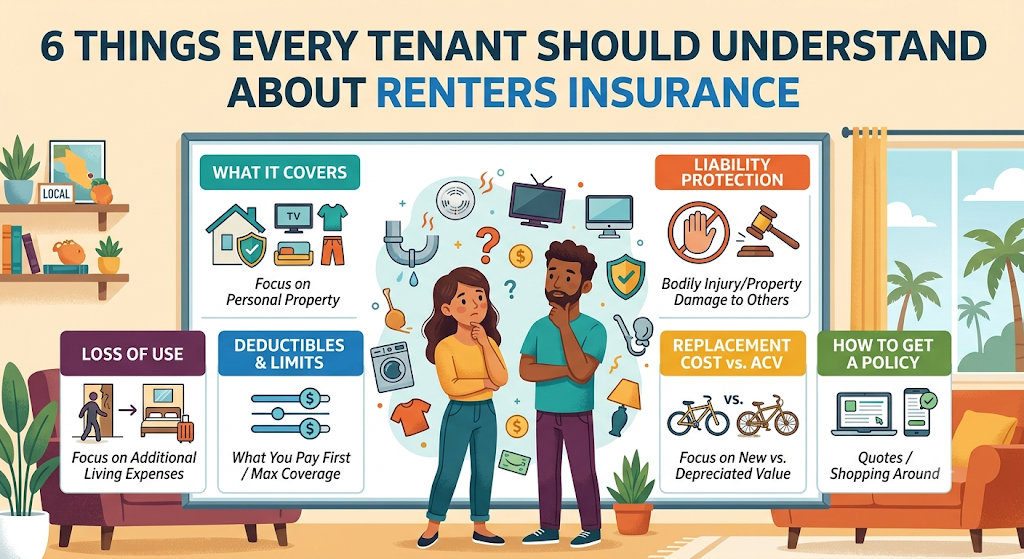
1. Your Landlord's Policy Protects the Building, Not Your Belongings
This is the foundational misunderstanding. Property insurance held by an owner covers the structure — walls, roof, systems, the physical building itself. It does not cover the contents that tenants bring in.
If a pipe fails and damages your furniture, the building's policy addresses the building. Your furniture is your responsibility. That's not a landlord being unhelpful; it's simply how the two types of coverage are structured.
2. Your Belongings Are Worth More Than You Think
People consistently underestimate the replacement value of what they own. The exercise that makes this concrete is straightforward: walk through your apartment and imagine replacing everything at once.
Laptop. Television. Phone. Bed and mattress. Couch. Dining table. Kitchen equipment. Every piece of clothing you own. Tools. A bicycle. Whatever is stored in the closet.
Most tenants who complete this exercise land on a number several times higher than their initial guess. That number is what you'd be replacing out of pocket without coverage.
3. Liability Coverage May Matter More Than Contents Coverage
The part of a renters policy people overlook is liability protection. If a guest is injured in your apartment, or if something you're responsible for causes damage that extends beyond your unit, liability coverage addresses the resulting claims.
For many tenants this is the more consequential half of the policy, even though contents coverage is what prompts them to buy it.
4. Displacement Coverage Fills a Real Gap
Most policies include some provision for additional living expenses if your home becomes temporarily uninhabitable. If a covered event forces you out for a period, that coverage helps with the cost of staying elsewhere.
Being suddenly displaced is disruptive enough without also absorbing an unplanned expense.
5. Know the Difference Between Two Types of Reimbursement
Policies generally reimburse in one of two ways. Actual cash value pays what an item was worth at the time of loss, accounting for depreciation. Replacement cost pays what it would take to buy a comparable new item.
The difference is substantial on anything more than a few years old. A five-year-old television is worth very little in depreciated terms and considerably more to replace. Replacement cost coverage typically costs somewhat more and is usually worth the difference. Confirm which one you're getting rather than assuming.
6. Read What Isn't Covered
Every policy has exclusions, and they vary. Certain categories of loss are commonly excluded or limited, and high-value items such as jewelry, musical instruments, or specialized equipment often carry caps that require additional coverage to exceed.
If you own something whose loss would genuinely hurt, ask specifically how it's treated. The <a href="https://www.iii.org/ Insurance Information Institute</a> publishes consumer guidance on policy types and coverage limits that's useful for framing the questions.
Renters Insurance and Choosing Where You Live
Insurance protects against loss. Choosing a well-maintained community reduces the chance of needing it in the first place.
Anndell Park Apartments offers newly constructed one- and two-bedroom apartment homes in Kansas City, KS. Gas, water, and trash pickup are included in rent, with electricity billed separately. Lawn care and snow removal are handled by the community — which, beyond convenience, means walkways and grounds get attention through the winter.
Residents have off-street parking, a large outdoor space with grilling options, and in-unit washers and dryers. You can see the full list on our amenities page.
Questions About the Community?
We're happy to answer questions about the property, the units, or what to expect as a resident.
Contact Anndell Park Apartments or call (913) 299-9748. We're at 746 N 63rd St in Kansas City, KS.
This post is general information, not insurance advice. Talk to a licensed agent about your specific situation.